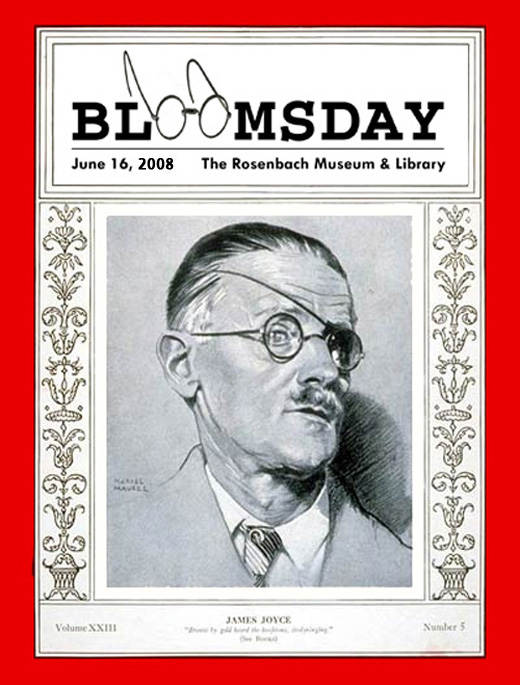
Showing posts with label Bloomsday. Show all posts

Wednesday, June 8, 2011

Bloomsday: A Very Brief History


Every year, we encourage our listeners to host their own Bloomsday listening party, at home, in a bar or wherever they like to celebrate. Tips and menu suggestions available here. One of our advisors here at Radio Bloomsday is Professor Michael Groden, the esteemed Joyce scholar. He is Distinguished University Professor in the Department of English at the University of Western Ontario in London, Ontario, Canada. He is the author of Ulysses in Progress, general editor of the manuscript facsimile series The James Joyce Archive, and author, most recently, of Ulysses in Focus: Genetic, Textual, and Personal Views. Below, Professor Groden explains the history of the world's most famous literary holiday.

Bloomsday: A Very Brief History
June 16, 1904 – Bloomsday – is surely the most famous single day in literature, a day celebrated all over the world. As its 2004 centenary approached, a newspaper headline shouted, One Day Turns 100. Why the day is famous is clear: James Joyce set the events of Ulysses on that day. Why Joyce chose this particular day is less certain. He never said why, and we can only speculate. Not much happened in the world on that day – at least in the Western world – but newspapers did report big events from the days before, including a Russian retreat in the Russo-Japanese War and the sinking of the General Slocum excursion boat in New York’s East River, with the loss of over a thousand lives. According to Richard Ellmann’s biography, Joyce chose this date for a more personal reason, as a gift to his partner and eventual wife Nora to commemorate the day on which she first went out walking with him and changed his life.

Joyce’s first biographer, Herbert Gorman, who wrote with the novelist’s cooperation, claims that nothing unusual happened to Joyce on June 16th. Several scholars have pointed to the absence of letters or any other evidence to show that Joyce and Nora met on that specific day. Joyce might simply have settled on a day in mid-June around the time of his walk with Nora that met his main requirements: no major world events, no Saint’s Day in the Catholic Church. We can’t know. But Ulysses is a novel that tempers its sadness, satire, and irony with a hearty dose of sentiment, occasionally even with sentimentality. Ellmann’s sentimental explanation for the date remains powerful, the kind of story about a particular day that we’d like to believe is true.

Not long after Ulysses was published in 1922, June 16th began to be called Bloomsday. The Oxford English Dictionary added an entry on Bloomsday in 2005 and cites the word’s first appearance in a letter Joyce wrote in June 1924. The practice of gathering together on the day to celebrate started early on as well, in 1929, when Sylvia Beach and Adrienne Monnier invited Joyce and thirty other guests to a luncheon at the LĂ©opold restaurant near Versailles to honor both the publication of the French translation of Ulysses and Bloomsday’s 25th anniversary. The lunch took place on June 27, eleven days after Bloomsday, but no one seemed to mind.

For many years Dublin had a vexed relationship with Joyce, but the first celebration of Bloomsday there took place 57 years ago, on June 16, 1954. Irish writers Flann O’Brien and John Ryan brought a small group together at the Martello Tower, the setting of Ulysses’ first episode, and from there they took a Hades-like carriage ride through Dublin. One of the men, Anthony Cronin, noted with fascination that in the 1954 Gold Cup race, a horse with the Homeric name of Elpenor won at 50 to 1 odds, even more an outsider than Throwaway was in 1904. Leopold Bloom faces problems when several Dubliners mistakenly think that he has inside knowledge about the Gold Cup and has won a huge pile of money when the 20-to-1 long shot Throwaway wins the race. Especially intriguing to Cronin was the fact that Joyce’s equivalent of Elpenor in The Odyssey is Paddy Dignam, the man whose funeral Bloom attends in the Hades episode.

On June 16, 1967 the first gathering of Joyce scholars took place in Dublin, with academic conferences continuing as annual Bloomsday events in various European and North American cities. Popular celebrations have sprung up not only in Dublin (which started embracing Joyce in 1982, the centenary of his birth) but also in such diverse cities as New York, Philadelphia, Toronto, Buenos Aires, Tokyo, and Beijing. Many Dubliners now consider Bloomsday to be Ireland’s second most important holiday, and some even rank it above St. Patrick’s Day.

New York can lay claim to the longest continuous association of any city with Bloomsday. The James Joyce Society was founded at the late, lamented Gotham Book Mart in 1947. One of the Society’s meetings each year has usually been on Bloomsday. The annual readings at Symphony Space, broadcast on WBAI, began in 1981. This is Radio Bloomsday’s fourth annual reading devoted exclusively to radio performance and broadcast on the Pacifica Radio Network. So join us in celebrating Bloomsday’s 107th anniversary in the best way we can think of: listening to the people and the city of Dublin, and the day come alive in the words James Joyce gave us on the pages of Ulysses.


Friday, May 21, 2010

How to throw a Bloomsday Party


To put together your own Bloomsday celebration, all you need is a copy of Ulysses, an internet connection or a radio. Some drinks and snacks mentioned in the book are also a nice touch if you are inviting friends: Beer, burgundy, tea, brown bread, gorgonzola cheese, for instance. At 7pm EST, you turn on the radio and listen to wbai 99.5FM or go online to wbai.org.


You can also pass around your copy of Ulysses to your guests or choose selections for them to read and print them out and let them each in turn read aloud from the book. Edwardian dress is optional but always encouraged, long dresses and bowler hats and nightgowns are welcome. Bloomsday is a day for people who love the book to share it with people who have never read it, to help new readers find their way in to a challenging, inspiring, rewarding and for some life changing literary experience.

The first Bloomsday celebration was a lunch organized by Joyce's publisher Sylvia Beach in Paris, 1929. The first Irish Bloomsday took place in 1954 as the great Irish poet Patrick Kavanaugh and novelist Flan O'Brien visited some of the places mentioned in Ulysses and read from the novel. Traditionally, Bloomsday starts at breakfast time with a nice Irish fry and ends drunkenly at 2ish in the morning. Take just five minutes to think of the book and listen to or read a few paragraphs and you have taken part in a worldwide literary celebration.

Thursday, May 20, 2010

How Jewish is Ulysses?


Much has been of the fact that James Joyce chose to make Leopold Bloom, the lead character in Ulysses, Jewish. Bloom's father is a Hungarian Jew who immigrated to Ireland. Bloom's mother is Irish. While according to Jewish law Bloom would not be considered Jewish, he is certainly looked upon as other by the Irish community in which he lives. While Ireland was a safe place for Jews to live in the early 1900's, Joyce highlights several moments of anti-semitism in the book. In episode two, the school teacher Mr Deasy tells Stephen Dedalus that: "England is in the hands of the jews. In all the highest places: her finance, her press. And they are the signs of a nation's decay." At the end of The Cyclops episode of Ulysses, the Citizen hurls a biscuit tin at Bloom's head and threatens to crucify him after Bloom says: "Mendelssohn was a jew and Karl Marx and Mercadante and Spinoza. And the Saviour was a jew and his father was a jew. Your God."

By making Bloom Jewish, Joyce was able to create a connection between this very Irish tale and communities the world over. Additionally, Bloom's Jewishness underlines his outsider status in Ireland something that Joyce himself felt keenly as artist in self-exile in Europe. In many ways both Bloom and Dedalus are stands in for Joyce. Bloom as the older man trying to provide for his family with his unreliable income and Stephen as a young artist attempting to make his mark on a people and a society not yet ready to listen to him.

There is some discussion that perhaps it is Molly Bloom and not Leopold who is Jewish. The background of Molly's mother, Lunita Laredo, is unknown and there are intimations throughout her monologue that she was an outsider of somesort, a gypsy, an artist or perhaps a Jew. One of the most memorable Jewish characters in all of Irish literature, is of course the whoremistress Madame Bella Cohen who appears in The Circe episode and is the subject of Bloom's filthy sexual fantasies. For Radio Bloomsday 2010, Charles Busch performs the role of Bella Cohen, Aaron Beall is Bloom and T. Ryder Smith is the narrator.

The twentieth century Jewish community in Ireland was very prominent with two Jewish mayors and several Jewish ministers of parliament coming from a community of fewer than 2000 people. The first Jewish mayor of Dublin, Douglas Briscoe is pictured above. Irish historian Cormac O'Grada has written a very informative book about the Jewish community in Ireland at the time entitled Jewish Ireland in the Age of Joyce. More recently, a film Shalom Ireland which you can preview at the link discusses the Jewish community in Ireland today.

Although Ulysses has been translated into several languages including Hebrew, there has never been a Yiddish translation of the book. For Bloomsday, 2005, I translated a few paragraphs between Bloom and his old girlfriend Mrs. Denis Breen aka Josie Powell which you can read here -


-- O, Mr Bloom, how do you do?
OT, REB BLOOM, VOS MAKT IR?
-- O, how do you do, Mrs Breen?
NU, VOS HERT ZIKH, FRAU BREEN?
-- No use complaining. How is Molly those times? Haven't seen her for ages.
FAR VOS ZOL IHK KVETSHN? UN VI GAYT MOLLY AF YEDN TEG? ICH HOB A LANGE TSAYT ZI NISHT GEZEN.
-- In the pink, Mr Bloom said gaily, Milly has a position down in Mullingar, you know.
IN BESTN GEZUNT HOT REB BLOOM GEZOGT MIT FRAYD. MILLY HOT A JOB IN MULLINGAR, DOKH.
-- Go away! Isn't that grand for her?
NISHT EMES! DOS IZ ZAYER GUT FAR IR, NISHT VOR?
-- Yes, in a photographer's there. Getting on like a house on fire. How are all your charges?
YAU, BAY A FOTOGRAFER DORTN. S’IZ VI SHABES ALE VOKH. VI GAYT DI KINDER?
-- All on the baker's list, Mrs Breen said.
K’HOB NAKHES HOT FRAU BREEN GEZOGT
How many has she? No other in sight.
VIFL HOT ZI? KAYN ANDERE ZAY IHK NISHT
-- You're in black, I see. You have no...?
IR TUT AN SHVARTZE KLAYDER, ZAY ICH, IR HOT NISHT GEHAT KAYN -
-- No, Mr Bloom said. I have just come from a funeral.
NAYN, HOT MR BLOOM GEZOGT, ICH BIN YEZT TSURIK GEKUMEN OF A LAVAYA
Going to crop up all day, I foresee. Who's dead, when and what did he die of? Turn up like a bad penny.
S’VET ARAYNKHAPN ALE TOG, IKH ZAY, VER IZ TOIT, VEN UN FUN VOS IZ ER GESHTORBN, SVET ARAYN KHAPN VI CHOLERIA
-- O dear me, Mrs Breen said. I hope it wasn't any near relation.
OY VAY IZ MIR, FRAU BREEN HOT GEZOGT, IKH HOF AZ S’IZ NISHT GEVEN KAYN KROVIM
May as well get her sympathy.
A BISL MITLAYD, FAR VOS NIT?
-- Dignam, Mr Bloom said. An old friend of mine. He died quite suddenly, poor fellow. Heart trouble, I believe. Funeral was this morning.
DIGNAM HOT REB BLOOM GEZOGT, AN ALTE FRAYNT MAYN. ER IZ GESHTORBN ZAYER PLUTZLING, NEBEKH. TSUROS MITN HARTS MAYN IKH. DI LAVAYA IZ GEVEN IN DER FREE.
Your funeral's tomorrow
While you're coming through the rye.
Diddlediddle dumdum
Diddlediddle...

DAYN LAVAYA IS MORGN
VEN DU KUMST DURCHN RYE
YADADIE DIE DIE
YADADEE DEE DEE

-- Sad to lose the old friends, Mrs Breen's womaneyes said melancholily.
S’IZ ZAJER TROIERK VEN DI ALTE KHAVERIM GAEYN, FRAU BREENS OIGN HAT MIT TROIER GEZOGT
Now that's quite enough about that. Just quietly: husband.
GENUG SHOIN. SHA STIL – IR MAN.
-- And your lord and master?
UN IR GRAF UN BALABUS?
Mrs Breen turned up her two large eyes. Hasn't lost them anyhow.
FRAU BREEN HOT AB GEDRAYT IR ZVAI GROISE OIGN. ZI HOBN ZAY NISHT GELOZT, MIRTSHASHEM
-- O, don't be talking! she said. He's a caution to rattlesnakes. He's in there now with his lawbooks finding out the law of libel. He has me heartscalded. Wait till I show you.
OY! SHA, ZI HOT GEZOGT. A DYBUK IZ ARAYN IN IM. ER HAK MIKH A TCHAINIK. ER IZ ARAYN DORTN MITN TALMUD ZUKNDIK A DAVAR TOIRA VEGN LOSHN-HORE, IKH’LL ES AKYH BAVIZN.

Thursday, May 13, 2010

What is Bloomsday?


Bloomsday is a literary holiday. It is celebrated each year on June 16th commemorating the day that James Joyce's epic novel, Ulysses, takes place - on June 16th, 1904. Joyce chose this date for his novel in honor of the first time he went out walking with his future wife, Galway girl, Nora Barnacle the inspiration for the character of Molly Bloom.

Ulysses is considered by many to be the greatest novel of the twentieth century. Certainly, it popularized the stream of conscious monologue within literary texts. James Joyce was born in Dublin, Ireland in 1882. He spent most of his writing life in exile in Paris and Zurich where he died in 1941.

On Bloomsday every year, actors, writers and readers of all sorts get together and read Ulysses aloud. These celebrations take place onstage, in the street, in private homes, on the beach and in our case, broadcast live on the radio from 7pm to 2am on WBAI, 99.5FM or wbai.org anywhere in the world.

One of the most famous chapters in Ulysses is the final Penelope episode or the Molly Bloom monologue which takes place as Molly is lying in bed, thinking about her day, her lovers, her life. Consisting of eight very long run on sentences without punction, Molly Boom's solilquoy is a sexy, powerful, magical piece that takes 3 hours to perform. Caraid O'Brien will be performing the entire Molly Bloom monologue this year beginning at 11pm.

In the photo above, the actress Marilyn Monroe reads Molly Bloom's thoughts from Ulysses.